
The AI Catch-22: how AI can be right, yet the capital behind it can still lose
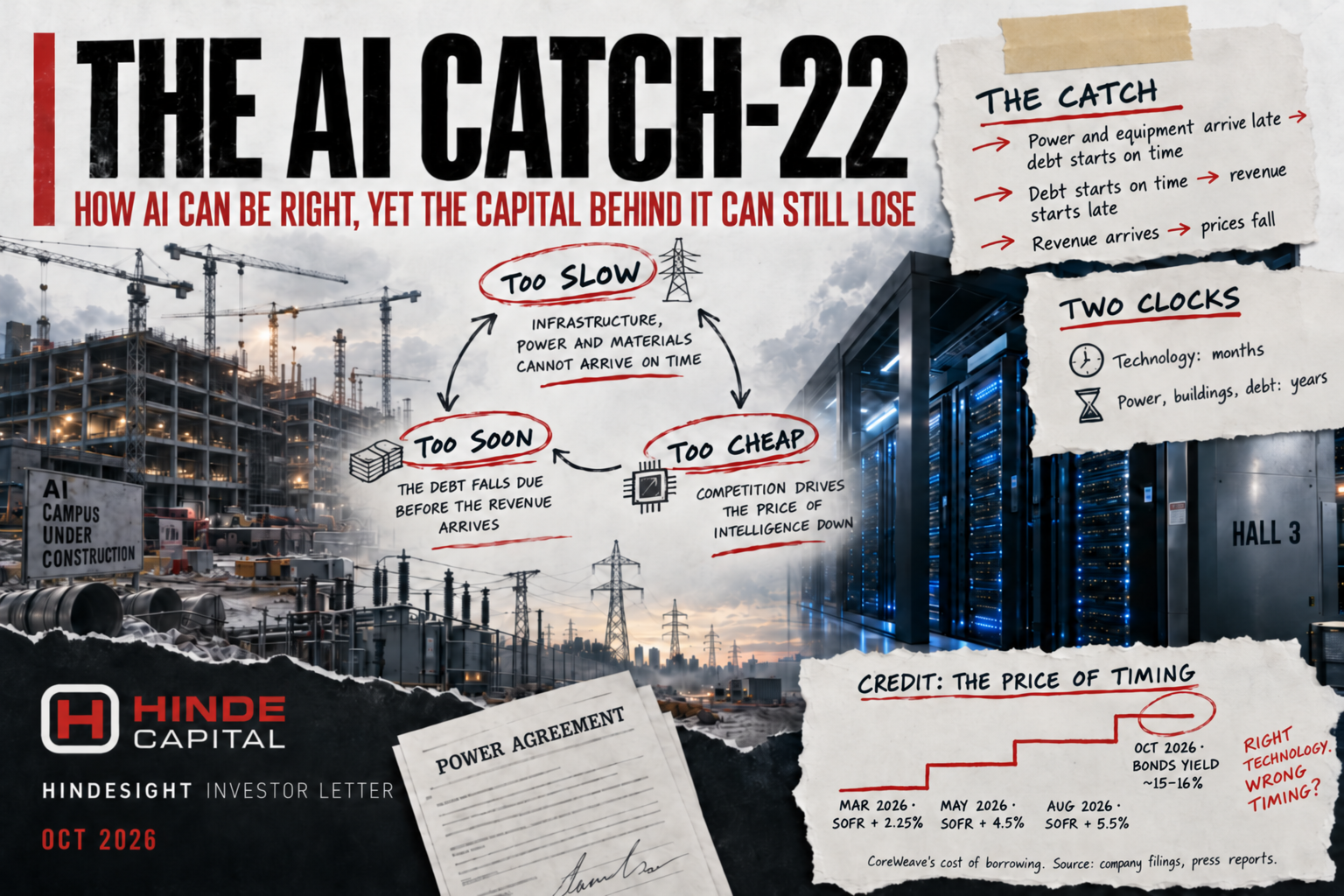
The October letter is one thesis in three parts, and it fits in a sentence: the AI build cannot be completed on the timetable its financing assumes, at the cost its financing assumes.
In Joseph Heller's Catch-22, a pilot could be excused from flying if he was mad, but asking to be excused proved he was sane. There was no way out. The AI build has a catch of its own: each escape from one problem leads into the next. The power, equipment and materials arrive too slowly for the loans already taken out. The debt falls due too soon, before the revenue can start. And when the revenue does arrive, competition may make intelligence too cheap for the owners to earn back what they spent. None of it requires the technology to fail.
The technology can be right. The financing can still be early.
The series measures everything in three units. Fix these and the rest follows.
The series in the figures worth remembering. Each is explained and sourced in the part named.
HS Chart Note About $1.1 trillion of debt exists and about $3 trillion more is promised. The plans call for $3 trillion to $7 trillion of spending. To earn a 12% return, that spending would need about $8.5 trillion of revenue by 2030; Gartner expects about $3.6 trillion. The financing is built on the top rung of the ladder; the revenue is on the one below it.
Source: Morgan Stanley Research (Jul 2025) and Morgan Stanley via Bloomberg Law (Aug 2026); Morgan Stanley (Oct 2026); Goldman Sachs via Cleary Gottlieb (Sep 2026); Gartner (Oct 2026); HindeSight analysis.
How to read the numbersPlanned is not built, committed is not drawn, a year's issuance is not the stock of debt, gross is not net, and a run-rate is not revenue. Part I sets these out in a short panel.